a guide to get you through your first yoga class
If you’re considering starting yoga but don’t know the lingo, or you’ve been to a class and heard strange words like Pranayama or Chaturanga and had no idea what the teachers talking about, then stick around because this article is for you! Below I have shared the ‘beginners guide’ to some of the more commonly used words and phrases that you’ll hear at a yoga class and what they mean, so when your yoga teacher tells you to find your drishti, you’ll know exactly what to do!
It’s common for yoga teachers to use a mix of Sanskrit (the Indian language used in yoga) and English to guide their students through classes. And of course this can be confusing, especially for a beginner. Not only are you learning new movements and breathing techniques, you’re being told to do it in an unfamiliar language! But with consistent practice, you’ll pick up the jargon in no time and it will begin to make sense and start to come naturally.
‘Namaste’ (na • mah • stay)
Greetings
It’s very likely you’ve heard of this word before, but do you know what it really means? The word namaste is an important and significant word, but not traditionally through the practice of yoga.It doesn’t mean thank you, or goodbye, and is actually not an ending at all! Namaste is in fact a greeting, a formal way for Hindi speakers to address their elders or people they don’t know well.
The use of namaste to end a yoga class was developed in westernised modern yoga, and in more recent times has caused controversy within the yoga community, with many now questioning it’s appropriation within yoga classes, and many yoga teachers are now choosing not to use it. So, you may hear it, you may not, either way I’ve included it because if you’re going to practice yoga it’s important to understand the true meaning, particularly if you decide to use it yourself.
‘Asana’ (as • ah • na)
Seat / posture
A Sanskrit word that literally translates to seat, however the more modern interpretation of the word indicates more to posture or placement. Asanas are the poses we perform during a physical yoga practice, and each asana has a name in both Sanskrit and English. There are hundreds of different anasas in yoga, but they all come with the same simple principles of alignment. An asana can be a static pose that is held for a series of breaths, or it can be part of a moving sequence that is held for one or two breaths before moving on to the next.
‘Pranayama’ (pran • a • yam • ma)
Prana – life force energy / Yama – control
Often shortened to ‘prana’, Pranayama is Sanskrit for the practice of focusing or controlling your breath using many different techniques and lengths of time through meditation or asana. The aim of prana is to connect your body to your mind and promote a sense of deep relaxation. So you teacher may say something like ‘connect to your prana’, meaning to focus on your breath.
‘Drishti’ (drish • tee)
Eyesight / Vision
The act of focusing your gaze to develop concentration. It aids in reducing your other senses in order to bring total awareness to the asana you are in.You find something in your direct eye-line to soften your gaze upon, something unmoving, which will allow you to find balance and hold the posture with ease.
Your teacher may say something like ‘find your drishti’ when you are in a balancing asana such as tree or eagle pose.
‘Chaturanga Dandasana’ (chat • ur • ang • ga)
Chatur – Four / Anga – limb / Danda – staff / Asana- pose
Chaturanga dandasana, usually just chaturanga, is one of the more well know asanas, in Vinyasa yoga, also known as flow yoga, and is part of a transitional sequence between high plank and upward facing dog that ends in downward facing dog. From high plank, lower the body down so it’s hovering just above the mat, elbows are in line with the body and core is engaged, this position is held for a breath before moving into upward facing dog. It is a challenging pose that requires full body strength and alignment, so practicing chaturanga regularly will build the foundations for a strong practice.
‘Bandhas’ (ban • das)
Lock
Bandhas means to lock, tighten, or control and lock in life force energy to a single point within. Engaging the bandhas strengthens drishti (single point concentration), pranayama (controlled breath) and calms the mind. There are four types of bandhas; mula, jalandhara, uddiyana and maha. The one you will likely hear more than others in class is uddiyana bandhas (lifting of the diaphragm lock), which is to essentially pull your belly ‘in and up’, engaging your core and pulling yourself into alignment whilst practicing asanas. Your teacher may say something like ‘activate your uddiyaya bandhas’ or ‘pull the pit of your belly in and up’.
‘Savasana’ (shava • sana)
Sava – corpse / asana – pose
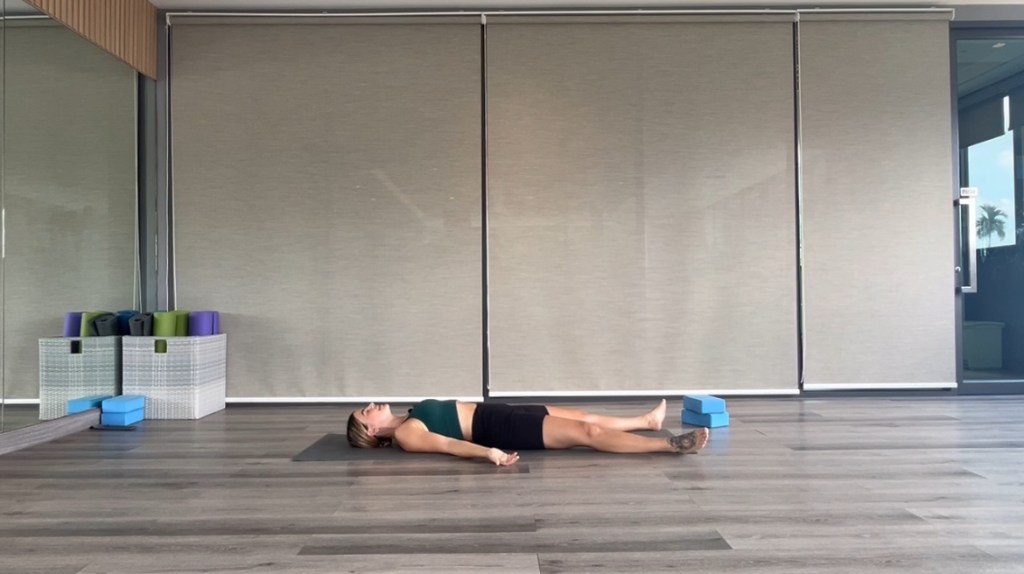
Aka corpse pose, savasana is the act of laying in a still position on your back, palms facing up, feet out wide with eyes closed, much like a corpse! As savasana is a resting asana, and is usually the final pose of the practice, to relax and reset your mind and allow the benefits of your practice to sink in. So you teacher may say something like ‘find your savasana’,or ‘come down to lay in savasana’ to signify that the physical part of your practice is over and it’s time to relax!
‘Mantra’ (man • tra)
Sacred message
The act of repeating of a word or phrase in your mind or out loud to encourage concentration during meditation. The most common mantra, and one you’ve likely heard before is Ohm. A small but powerful word that is said to be the origin of sound and is considered the ‘universal sound of all consciousness’. Om is usually chanted at the beginning and end of asana practice. Other mantras can be a positive word, phrase or affirmation that is chanted repeatedly at the end of class when you’re in savasana or meditating for motivation or encouragement.
‘Vinyasa’ (vin • yasa)
Nyasa- to place / Vi – special way
Vinyasa is a style of yoga where a sequence of two or more asanas are performed in a fluid motioned that is synchronised with the breath. The most well know vinyasa sequence is surya namaskar, aka the sun salutation, but you can perform any sequence of asanas in this style. You might hear your teacher say ‘flow through your vinyasa’ or ‘take a vinyasa’ as you transition through the‘chaturanga – upwards facing dog – downward facing dog’ part of the sequence.
‘Supine’ (sup • ine) // Supta (sup • ta)
To lay on your back
Almost all asanas can be performed in a supine, or supta position, literally meaning to lay on your back with your face pointing upwards. So it is likely you’ll hear this word added on the back of commonly know asanas, such as ‘supine pigeon’ or ‘supta baddah konasona’.
‘Ujjayi’ (oo • ja • yi)
Victory
A soft pranayama technique also known as victory breath or ocean breath. Its compared to the sound of the waves coming to shore or wind blowing through trees when practiced. Ujjayi is performed by breathing deeply in and out of your nostrils whilst constricting your throat so you are breathing through a thin passageway, it is this that causes the audible ‘oceanic’ sound as your breath flows in and out. Practicing ujjayi brings mental focus, full body awareness and has a calming effect on the mind.
‘Engage your core‘
A phrase you’ll most definitely hear at some point during a yoga class. To engage your core is to contract or brace the muscles surrounding your torso. Think pulling your belly button in and up towards your spine, then at the same time tucking your pelvis and squeezing your shoulder blades together and pulling them down your back– super challenging, right? If you can master this whilst practicing asanas you will bring your full body into alignment, which will protect your spine and pelvis during movement. Your yoga teacher may say something like ‘pull the pit of your belly in and up’,‘tuck your pelvis in’, ‘brace your core’, or ‘engage your core’ to get you into correct alignment.
Honestly, I could go on and on as there are loads, but I think this covers enough to get you through your first class!


 KNOW YOGA with Jess
Leave a comment